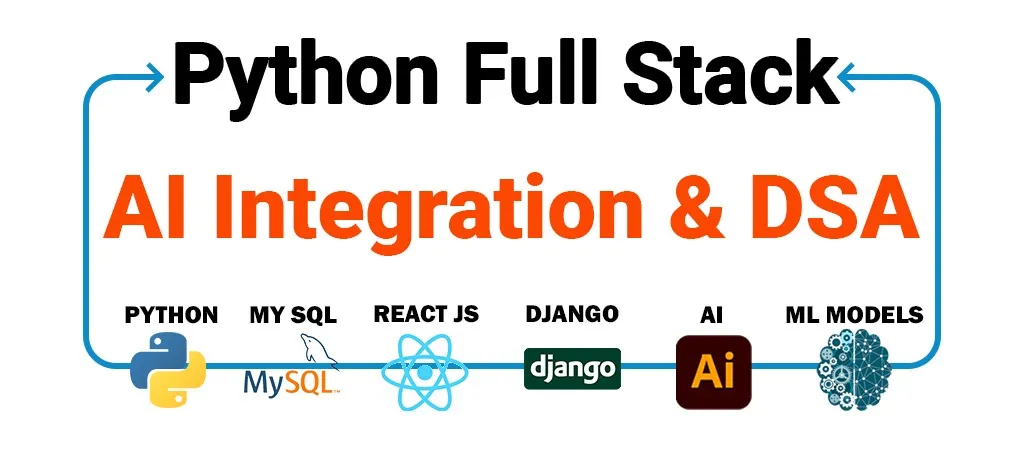
Python Full Stack with AI Integration & DSA
Build a future-ready software development career with our Python Full Stack with AI Integration & DSA Course at SIRI AI TECH HUB. This comprehensive program covers Python Programming, Data Structures & Algorithms (DSA), Frontend Development, Backend Development, Databases, REST APIs, AI Integration, Git, Deployment, and Real-Time Projects. Designed for beginners, graduates, and working professionals, the course combines hands-on practical training with industry-oriented projects to help you become a skilled Full Stack Python Developer equipped with modern AI development techniques.
Course Duration: 3 Months
Call Now
+91 9949299943
Office Address
4th floor, Outoff The Box, Mindspace Rd, P Janardhan Reddy Nagar, Gachibowli, Hyderabad, Telangana 500081
Company mail id
siritechhub@gmail.com
Python Full Stack with AI Integration & DSA
Module 1: Python Fundamentals
- What is Python?
- Why Python?
- History & Evolution of Python
- Applications of Python
- Features & Advantages
- Python Versions
- Installing Python
- Python Flavors
- Python vs C vs Java
Module 2: Python Programming Basics
- Python Execution Modes
- Interactive & Batch Modes
- Python Editors & IDEs
- Data Types
- Constants & Variables
- Comments
- Input & Output Functions
- Type Conversion
- Type() & Id() Functions
- Escape Sequences
- Strings, Indexing & Slicing
Module 3: Python Operators
- Arithmetic Operators
- Relational Operators
- Logical Operators
- Assignment Operators
- Bitwise Operators
- Membership Operators
- Identity Operators
Module 4: Flow Control Statements
- Indentation & Blocks
- Conditional Statements
- if, if-else, if-elif
- while Loop
- for Loop
- Nested Loops
- Range()
- Break, Continue & Pass
Module 5: Strings in Python
- String Creation
- Indexing & Slicing
- String Operations
- Concatenation
- Comparison
- Splitting & Joining
- Finding Substrings
- Case Conversion
- String Methods
Module 6: Collections in Python
- Lists
- Tuples
- Sets
- Dictionaries
- Collection Operations
- Nested Collections
- Collection Functions
- Difference between List, Tuple, Set & Dictionary
Module 7: Python Lists
- List Properties
- List Creation
- Indexing & Slicing
- List Operations
- Nested Lists
- List Modification
- Insert & Delete Operations
Module 8: Python Tuples
- Tuple Properties
- Tuple Creation
- Indexing & Slicing
- Tuple Operations
- Nested Tuples
- Tuple Methods
- List vs Tuple
Module 9: Python Sets
- Set Properties
- Set Creation
- Set Operations
- Mathematical Operations
- Set Methods
- Insert & Delete Operations
Module 10: Python Dictionaries
- Dictionary Properties
- Dictionary Creation
- Dictionary Operations
- Dictionary Methods
- Insert & Delete Elements
- List vs Tuple vs Set vs Dictionary
Module 11: Functions in Python
- Function Definition
- Calling Functions
- Parameters & Return Types
- Argument Types
- Variable Length Arguments
- Variable Scope
- Local & Global Variables
- Recursive Functions
- Boolean Functions
- Lambda Functions
- Filter() & Map()
Module 12: Modules & Packages
- Modules
- User Defined Modules
- Import Statements
- Module Search Path
- Module Aliases
- Standard Modules
- Packages
- Sub-Packages
Module 13: Exception Handling
- Compile-Time Errors
- Run-Time Errors
- Exception Handling
- Try, Except & Finally
- Multiple Exceptions
- User Defined Exceptions
- Raise Statement
Module 14: File Handling
- File Operations
- Read & Write Files
- Open & Close Files
- Tell() & Seek()
- File Functions
Module 15: Regular Expressions
- Regular Expressions
- Special Characters
- Pattern Matching
- Match()
- Search()
- Grouping
- Split()
- Replace()
Module 16: Object-Oriented Programming (OOP)
- OOP Concepts
- Classes & Objects
- Encapsulation
- Abstraction
- Inheritance
- Polymorphism
- Constructors & Destructors
- Method Overriding
- Super()
- Garbage Collection
Module 17: Advanced Python Concepts
- Iterators
- Generators
- Closures
- Decorators
- Web Scraping
- PIP
- CSV Files
- XML Files
- JSON Files
- Debugging
Module 18: Multithreading
- Threads
- Thread Module
- Thread Synchronization
- Thread Locking
- Thread Communication
- Priority Queue
Module 19: GUI Programming
- GUI Introduction
- Root Window
- Widgets
- Buttons
- Labels
- Checkboxes
- Text & Message Widgets
- Images
- Fonts & Colors
Module 20: Database Programming
- Database Concepts
- Oracle Installation
- Database Users
- Python Oracle Modules
- Database Connections
- Cursor Object
- SQL Execution
- Data Retrieval
- Bind Variables
- Transactions
- Error Handling
Module 21: Date & Time in Python
- Date Class
- DateTime Class
- Time Objects
- Calendar Module
- Time Module
Module 22: Operating System Module
- OS Module Introduction
- getcwd()
- listdir()
- chdir()
- mkdir()
- Rename Files & Directories
- Remove Files & Directories
- OS Operations
Python Course Highlights
- 100+ Hours of Instructor-Led Training
- Industry-Oriented Curriculum
- Real-Time Projects & Internships
- AI-Integrated Learning Approach
- Hands-on Coding Sessions
- Dedicated Placement Support
- 28+ Job-Ready Skills
- Expert Trainers with 12+ Years of Experience
- Backup Classes & Recorded Sessions
- Guest Lectures by Industry Experts
- Mock Interviews & Resume Preparation
- 100% Placement Assistance
Contact Us
Ready to start your IT career? Get in touch with our team for course details, batch schedules, demo sessions, and enrollment assistance. We’re here to guide you every step of the way.
Office Address
4th floor, Outoff The Box, Mindspace Rd, P Janardhan Reddy Nagar, Gachibowli, Hyderabad, Telangana 500081
Company mail id
siritechhub@gmail.com
Call Now
+91 9949299943
Get In Touch With Us!
Python Full Stack with AI Integration & DSA
Best Python Full Stack Training in Hyderabad
Python is one of the most powerful, beginner-friendly, and versatile programming languages used for Web Development, Full Stack Development, Artificial Intelligence, Machine Learning, Data Science, Automation, Cloud Computing, and Software Development. Its simple syntax, extensive libraries, and cross-platform capabilities make it the preferred choice for developers and organizations worldwide. Our Python Full Stack with AI Integration & DSA course is designed to help students master Python programming from fundamentals to advanced concepts while building real-world, industry-ready applications.
At SIRI AI TECH HUB, our curriculum combines Python Programming, Full Stack Web Development, Data Structures & Algorithms (DSA), AI Integration, Database Management, REST APIs, Git & GitHub, and Real-Time Projects into one comprehensive learning path. Students gain hands-on experience through coding exercises, live projects, AI-assisted development, mock interviews, and placement-oriented training. The course is suitable for beginners, graduates, working professionals, and anyone looking to build a successful career as a Python Full Stack Developer.
Our experienced trainers provide practical, project-based learning with individual mentorship in small batches to ensure every student receives personalized attention. Along with technical training, students receive resume preparation, interview guidance, aptitude sessions, soft skills training, and placement assistance. By the end of the course, learners will be confident in developing scalable web applications, integrating AI capabilities, solving coding challenges using DSA, and meeting the expectations of today’s software industry.
Why Choose SIRI AI TECH HUB for Python Full Stack Training?
- Industry-Oriented Curriculum with AI Integration
- Python from Beginner to Advanced Level
- Full Stack Web Development with Real-Time Projects
- Data Structures & Algorithms (DSA) Training
- Live Coding Sessions & Hands-on Assignments
- Git, GitHub & REST API Development
- Mock Interviews & Resume Preparation
- Expert Trainers with Industry Experience
- Small Batch Size for Individual Attention
- Internship & Placement Assistance
- Online & Classroom Training Available
- Career Guidance and Certification upon Course Completion
What is Python?
Python is a powerful, high-level, and versatile programming language used for developing web applications, software solutions, automation tools, artificial intelligence, machine learning, data science, and cloud-based applications. Known for its simple syntax and readability, Python enables developers to write clean, efficient code while reducing development time. Its extensive libraries and cross-platform compatibility make it one of the most preferred programming languages for beginners as well as experienced professionals.
History of Python
Python was created by Guido van Rossum in the late 1980s as a successor to the ABC programming language. It was designed to overcome the limitations of ABC while providing a simple, readable, and highly productive programming experience. Since its first release, Python has continuously evolved into one of the world’s most widely adopted programming languages, powering everything from web applications to AI systems and enterprise software solutions.
Applications of Python
Python is widely used across multiple technology domains due to its flexibility and extensive ecosystem.
Artificial Intelligence & Machine Learning
Python is the leading language for AI and ML development, offering powerful libraries such as TensorFlow, Scikit-Learn, Keras, and PyTorch to build intelligent applications, predictive models, and deep learning solutions.
Web Development
Python enables developers to create scalable and secure web applications using popular frameworks such as Django, Flask, and FastAPI, making it a preferred choice for startups and enterprises.
Data Science & Analytics
Python simplifies data collection, processing, visualization, and statistical analysis using libraries like Pandas, NumPy, and Matplotlib, making it an essential tool for data scientists and analysts.
Business Applications
Python is widely adopted for ERP systems, CRM solutions, workflow automation, financial applications, and enterprise software because of its scalability and flexibility.
Automation & Scripting
Python automates repetitive tasks, file management, testing, reporting, and system administration, significantly improving productivity and reducing manual effort.
How Long Does It Take to Learn Python?
Python is considered one of the easiest programming languages to learn because of its simple syntax and easy-to-understand structure. Beginners can learn the fundamentals within a few weeks through consistent practice, while advanced topics such as Full Stack Development, Artificial Intelligence, and Data Science require additional project-based learning. Our Python Full Stack with AI Integration & DSA program provides a structured, industry-oriented curriculum designed to help students become job-ready through practical training and real-world projects.
Future of Python
Python continues to dominate modern software development and remains one of the fastest-growing programming languages worldwide. Its widespread adoption in Artificial Intelligence, Machine Learning, Data Science, Cloud Computing, Cyber Security, Automation, and Full Stack Development has created exceptional career opportunities. As businesses increasingly rely on AI-powered applications and data-driven technologies, Python professionals remain in high demand across startups, product companies, and multinational organizations.
Why Learn Python at SIRI AI TECH HUB?
At SIRI AI TECH HUB, our Python Full Stack with AI Integration & DSA course is designed to provide both theoretical knowledge and practical expertise. Students learn through live coding sessions, real-time projects, AI-integrated development, coding challenges, and hands-on assignments. Our expert mentors guide learners from Python fundamentals to advanced full-stack development while helping them build industry-ready applications and strong problem-solving skills.
Course Objectives
- Understand Python programming fundamentals and advanced concepts.
- Build Full Stack Web Applications using Python technologies.
- Learn AI Integration and Data Structures & Algorithms (DSA).
- Develop REST APIs and database-driven applications.
- Work on real-time industry projects.
- Gain practical coding experience with Git and deployment tools.
- Prepare for technical interviews with mock interviews and coding practice.
- Become job-ready for Python Full Stack Developer roles.
Who Can Join This Course?
- Beginners with no programming experience.
- B.Tech, B.Sc, BCA, B.Com, MCA, M.Tech, and Degree Graduates.
- Working professionals looking to upskill.
- Students interested in AI, Automation, Web Development, or Software Engineering.
- Anyone aspiring to build a successful career as a Python Full Stack Developer.