
SOC Analyst Roadmap: A Step-by-Step Guide to Building a Cybersecurity Career
Cybersecurity is becoming an increasingly important part of modern technology. As organizations depend more on digital systems, networks, applications, and cloud environments, they need skilled professionals who can monitor security activity, identify threats, and respond to incidents.
One of the popular career paths in cybersecurity is becoming a SOC Analyst.
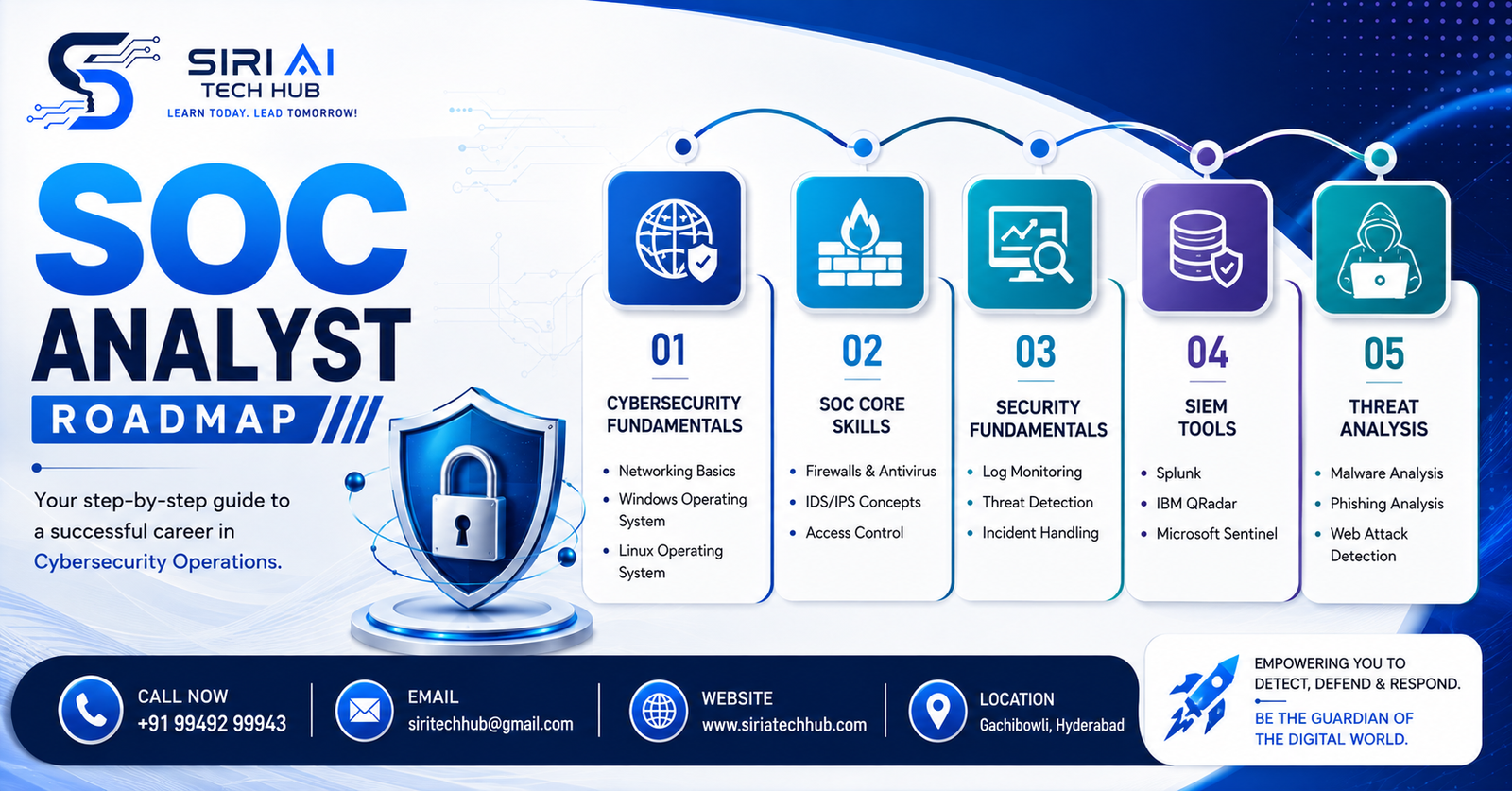
But what exactly does a SOC Analyst need to learn? Which skills and tools are important? This SOC Analyst Roadmap provides a structured path covering cybersecurity fundamentals, SOC core skills, security fundamentals, SIEM tools, and threat analysis.
What Is a SOC Analyst?
A Security Operations Center (SOC) Analyst focuses on monitoring and analyzing security events within an organization. The role involves identifying suspicious activity, investigating potential threats, and supporting incident response.
To build a strong foundation, learners need to understand networking, operating systems, security concepts, monitoring tools, and different types of cyber threats.
SOC Analyst Roadmap
The learning journey can be divided into five important stages.
1. Cybersecurity Fundamentals
The first step is developing a solid understanding of basic IT and cybersecurity concepts.
Key areas include:
- Networking Basics
- Windows Operating System
- Linux Operating System
Understanding networking helps you learn how systems communicate and how suspicious network activity can be identified. Windows and Linux knowledge is also important because security teams commonly work with different operating environments.
A strong foundation makes it easier to understand advanced SOC concepts later.
2. SOC Core Skills
After learning the fundamentals, the next stage is developing essential SOC skills.
Important topics include:
- Firewalls & Antivirus
- IDS/IPS Concepts
- Access Control
Firewalls help control network traffic, while antivirus technologies help detect malicious software. IDS and IPS concepts introduce learners to monitoring and preventing suspicious network activity.
Access control is another important security concept because organizations need to control who can access systems, applications, and data.
3. Security Fundamentals
The next stage focuses on understanding how security teams monitor and respond to potential incidents.
The roadmap includes:
- Log Monitoring
- Threat Detection
- Incident Handling
Logs provide valuable information about activities occurring across systems and networks. Learning how to analyze logs helps SOC professionals recognize unusual behavior.
Threat detection focuses on identifying potentially harmful activity, while incident handling introduces the process of responding to security events.
4. SIEM Tools
SIEM (Security Information and Event Management) tools are an important part of SOC operations.
The roadmap highlights three widely used SIEM platforms:
- Splunk
- IBM QRadar
- Microsoft Sentinel
Learning SIEM concepts helps students understand how security events and logs can be collected, monitored, and analyzed from different sources.
For aspiring SOC Analysts, gaining practical exposure to SIEM platforms can help connect theoretical cybersecurity knowledge with real-world security monitoring workflows.
5. Threat Analysis
The final stage of the roadmap focuses on understanding and analyzing common cyber threats.
Important areas include:
- Malware Analysis
- Phishing Analysis
- Web Attack Detection
Malware analysis helps learners understand malicious software and suspicious behavior. Phishing analysis focuses on recognizing deceptive messages and attempts to steal sensitive information.
Web attack detection introduces learners to identifying suspicious activities targeting web applications and services.
Why Follow a SOC Analyst Roadmap?
Cybersecurity contains many different technologies and concepts. Trying to learn everything at once can become confusing, especially for beginners.
A structured SOC Analyst Roadmap provides a logical learning sequence:
Fundamentals → SOC Skills → Security Concepts → SIEM Tools → Threat Analysis
Following this progression can make the learning process more organized and easier to understand.
Build Your Cybersecurity Skills
Becoming a SOC Analyst requires continuous learning and practical skill development. Start with networking and operating systems, strengthen your security fundamentals, understand SOC operations, gain exposure to SIEM tools, and then move toward threat analysis.
If you’re planning to start a career in cybersecurity, having a clear roadmap can help you understand what to learn and where to focus your efforts.
Start Your Cybersecurity Learning Journey with SIRI AI TECH HUB
SIRI AI TECH HUB focuses on technology-oriented learning and career-focused training.
📞 Call Now: +91 99492 99943
📧 Email: siritechhub@gmail.com
🌐 Website: www.siriaitechub.com
📍 Location: Gachibowli, Hyderabad
SIRI AI TECH HUB — Learn Today. Lead Tomorrow! 🚀
Frequently Asked Questions
1. What is a SOC Analyst?
A SOC Analyst works with security monitoring, threat detection, log analysis, and incident handling to help identify and respond to cybersecurity events.
2. What should I learn first to become a SOC Analyst?
Start with networking basics and Windows and Linux operating systems before progressing to SOC and security concepts.
3. Which SIEM tools are included in this SOC Analyst Roadmap?
The roadmap covers Splunk, IBM QRadar, and Microsoft Sentinel.
4. Is threat analysis important for a SOC Analyst?
Yes. Malware analysis, phishing analysis, and web attack detection are key areas included in the roadmap.
5. Is a roadmap useful for cybersecurity beginners?
Yes. A structured roadmap can help beginners organize their learning journey from fundamental concepts to more specialized cybersecurity topics.